

STAY UPDATED WITH
Best Networks for USDT Staking: TRC20 vs ERC20 vs BEP20
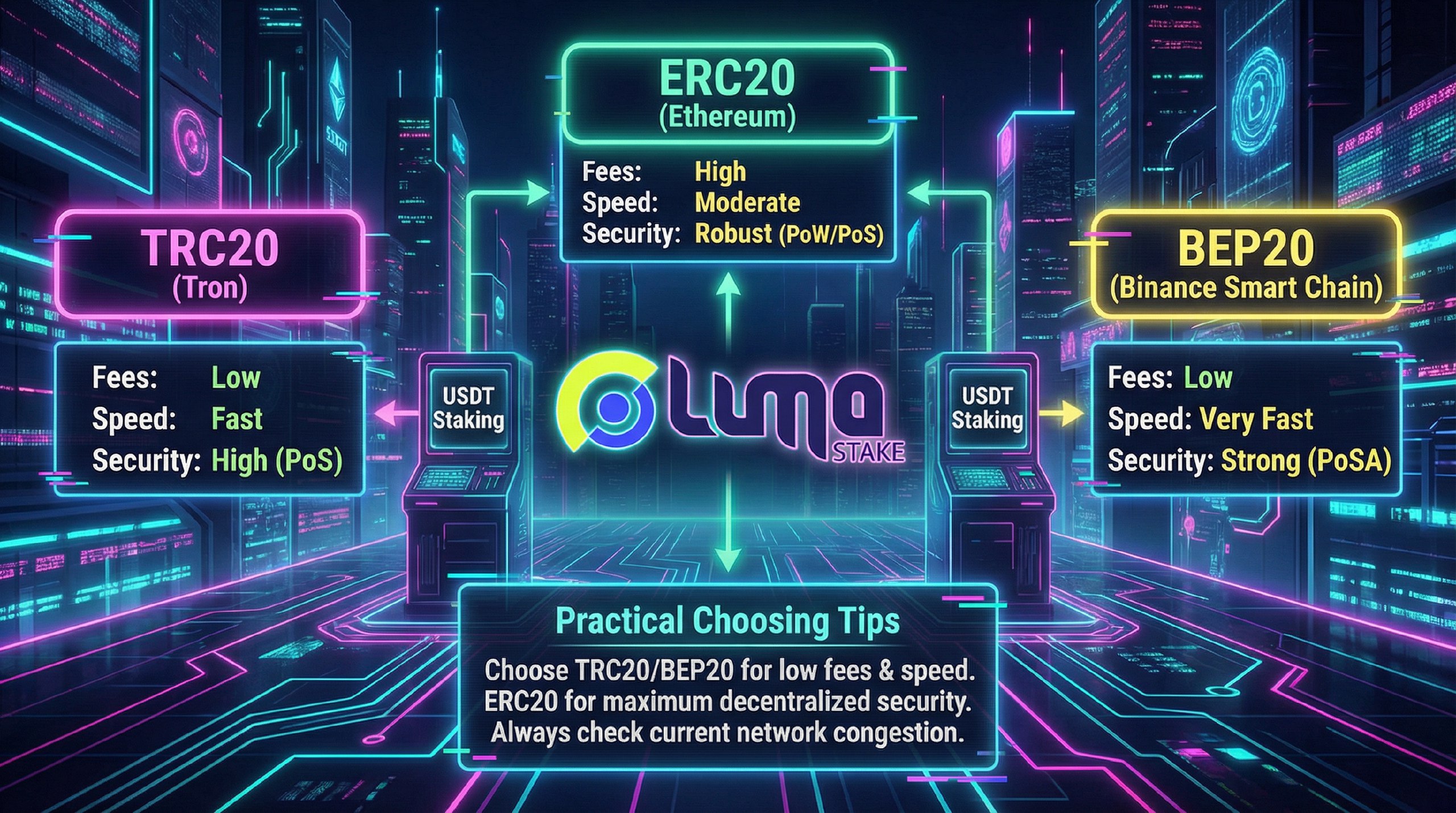
When users first explore stablecoin staking, they often focus on returns and tiers.
But in practice, one of the most important decisions happens earlier:
Which network should you use to transfer USDT?
Choosing the right network affects:
-
transaction fees
-
transfer speed
-
compatibility with platforms
-
operational convenience
Understanding these differences is essential for efficient staking in 2026.
Overview of the Three Main Networks
TRC20 (Tron)
Known for:
-
very low transfer fees
-
fast confirmations
-
wide support across exchanges
Because of this, TRC20 is frequently chosen for cost-efficient staking deposits.
ERC20 (Ethereum)
ERC20 remains:
-
the most widely integrated standard
-
highly secure and decentralized
-
compatible with institutional infrastructure
However, it may involve:
-
higher gas fees
-
slower confirmations during congestion
BEP20 (BNB Chain)
BEP20 offers a balance between:
-
low fees
-
fast speed
-
strong ecosystem integration
It is commonly used by users active in the BNB Chain environment.
Key Factors When Choosing a Network
1. Fees
Frequent transfers → TRC20 or BEP20 often preferred.
2. Platform compatibility
Always verify which networks are supported by the staking platform.
3. Security perception
Some users prefer Ethereum’s long-term track record.
4. Withdrawal convenience
Using the same network for deposit and withdrawal reduces friction.
How LumaStake Supports Network Flexibility
LumaStake allows:
-
USDT and USDC deposits
-
multiple supported networks
-
simplified participation flow
This helps users prioritize efficiency and clarity, not technical barriers.
Conclusion
The “best” network depends on your priorities:
-
lowest cost → TRC20
-
strongest ecosystem history → ERC20
-
balanced efficiency → BEP20
Understanding these trade-offs leads to smoother staking participation.
CTA:
Check supported networks and choose the most efficient option directly on LumaStake.
Share this article


Recommended Articles

When Noise Fades, Structure Wins
Crypto has never suffered from a lack of opportunities. It has suffered from a lack of discipline. Every market cycle brings new narratives, louder p...
Read More
How Arbitrage Generates Returns Without Predicting the Market
Most crypto strategies depend on price direction.Arbitrage is different. Instead of predicting the future, arbitrage focuses on: temporary price d...
Read More
Market-Neutral Crypto Strategies Explained
Why Arbitrage Matters More Than Market Direction Crypto markets move fast — and most people assume the only way to benefit is to predict...
Read More